Showing posts with label Astronomy. Show all posts

Wednesday, August 5, 2009

TSE2009 at Tawang - Arunachal Pradesh

My ill luck that I was not able to been places  where TSE2009  occurred fully , even in my place visibility was 90%, but we missed the phenomenon due to raining. 

JVP (Jyoti Vidya Parishantha) was on TSE2009 mission at Arunachal Pradesh, here some pics taken by Parimal Dave. Parimal is an amateur astronomer.

Part of his message:

Hi ......

We arrived back just yesterday night. We missed the Corona but could see the eclipse though the clouds.
 
.....Parimal


Solar Halo - 22 degree halo as observed from Tawang town

 
Eclipse - partial phase
 
Eclipse - partial phase 
 
 Eclipse - Before full  Eclipse
 
JVP team at Tawang Monastery - At work


Parimal, busy with his Telescope

 
Sky during Totality and Tawang Town under darkness
 
 End of eclipse
 
Rainbow - on the way to Sela Pass - (Arunachal Pradesh)


Sela Pass - (Arunachal Pradesh) - It was rainy - no snow - one of the highest motorable roads of the world
 
Heavy rains at Sela - very windy - less oxygen
 
The falls at Jang -No words
 
Flowers paradise at Sela pass

Tuesday, July 21, 2009

Up There


40 years ago some earthlings landed on the moon. Those earthlings landed on a place which was out of this world. That said symbolically something huge and its mean lot for human philosophically, although it was a scientific milestone in human history.


I used to read Flash Gordon comics in my teens and those were amazing reading time with wonderful graphics of outer world, space travel, cosmic perspective, time wrap, space adventure etc.  This picture (taken from the Moon in Apollo Mission) is one of my favorite pictures. It depicts a perspective which one now very much real, not like a fantasy adventure of Flash Gordon. The perspective which is altered our outlook as seeing things from earth perspective in opposite way. This picture let you allow sit outside of this world and you can participate in Einstein’s vision/experiment imaginatively and this picture and perspective let you allow to falling in love with 3rd planet of Sun Solar System called earth.


“Gatatri  Amavasya” was celebrated yesterday, from this day onward people of some part of India use to not eat Non-Veg/Alcohol for complete one month as this month from Indian calendar treated as sacred month traditionally.

Yes, I have got an invitation from a friend and I had some good eating/drinking time and spent a complete gambling night (teen patti/three cards, lose some money as end result).

Monday, July 13, 2009

TSE2009 - Live Workshop in SURAT


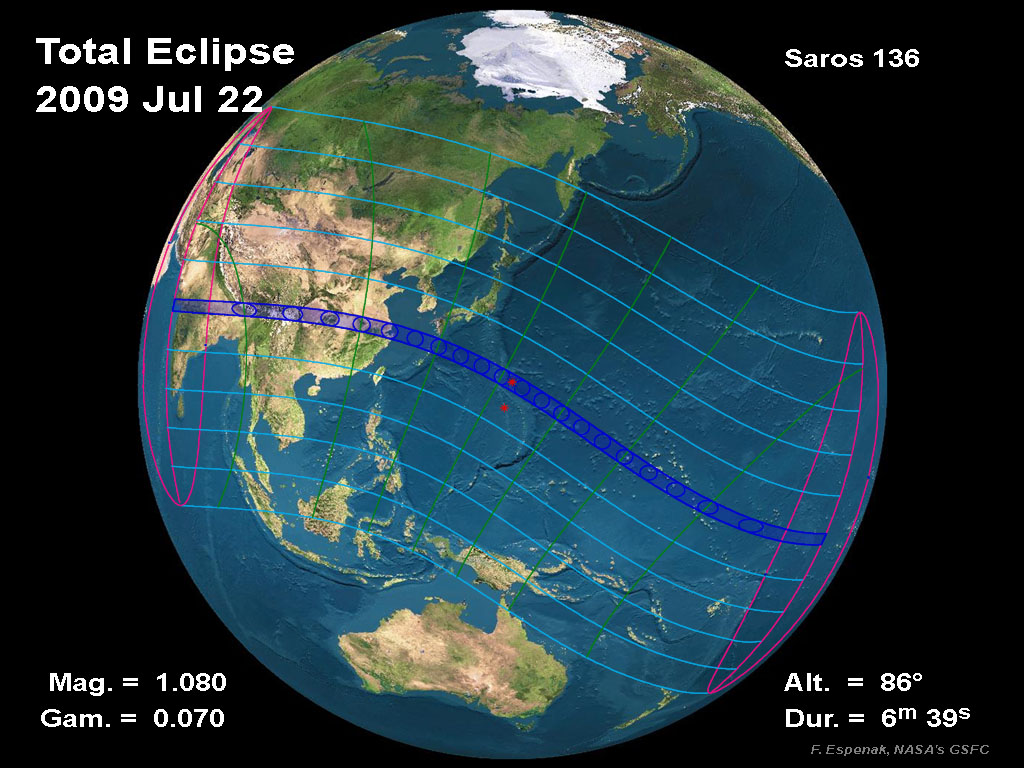
This year, on morning of 22nd of July, the umbral shadow of the moon will be passing over the rich heritage of our country. The Greatest eclipse of the century is just few days away from us and is tailor-made for India. It crosses the entire breadth of India starting from the westernmost state of Gujarat to the easternmost state, Arunachal Pradesh. The path of totality passes over 13 Indian states including the small area called the Chicken's Neck in West Bengal. Not only this, partial eclipse is visible throughout the country.


Total Solar Eclipse 2009 Program by Amateur Astronomers Association of Surat- AAAS

International Live Workshop on Total Solar Eclipse 2009
Total Solar Eclipse 22 July 2009
Live Webcast from SURAT !!!

Dear All,
AAAS is organizing a special event on "International Live Workshop on Total Solar Eclipse 2009" on 21-22 July 2009 collaboratively with Aatmiya Vidyamandir School at Surat. Eminent scientists ,from PRL and ISRO, and Astronomy experts are going to join the event.

Venue: Aatmiya Vidya Mandir- An International Residential School, Koli-Parthana Road, Taluka- Kamrej, District- Surat 394180

Date: 21-22 July 2009 (Tuesday-Wednesday)

Registration Fee: Rs.200/- Including Food, Accommodation and Kit

Those who have their own Telescopes/Binoculars/Solar Filters are requested to bring it with them. The campus and place is safe for all those Astronomy Items. Rest Assured!

Regards,
AAAS, Surat

Tentative Schedule:

Day- 1 : 21st July, 2009
11:00 - 11:30......Opening Ceremony
11:30 - 12:15......Keynote Address
12:15 - 1:00........Lecture-1
01:00 - 02:00......Lunch
02:00 - 03:00......Lecture-2
03:00 - 04:00......Lecture-3
04:00 - 04:15......Tea Break
04:15 - 05:00......Lecture-4
05:00 - 07:00......Group Activities
07:00 -08:00.......Dinner
09:00 - 10:00......Star Party

Day- 2: 22nd July, 2009
05:30 - 08:30.....Eclipse Viewing Programme
09:00 - 09:30.....Data Collection
09:30 - 10:00.....Breakfast
10:00..................Valedictory Function

For more information and Registration/Application visit here
Although now all type of rubbish, superstitious programs are started broadcasting on various mainstream media TV, ignore all these rubbish talk, discussion and if possible just witness this natural celestial phenomenon.
Only you need to take some guidance/precaution from expert  while observing TSE2009

Friday, May 8, 2009

Eyes on the Skies: 400 Years Of Telescopic Discovery


EYES ON THE SKIES - The International Astronomical Union's book and movie celebrating the 400th anniversary of the telescope.

THE INVENTION OF THE TELESCOPE has been by far the most revolutionary development in the history of astronomy. For thousands of years, astronomers had to rely on their eyes in unravelling the mysteries of the Universe. The telescope revealed an embarrassment of astronomical riches, and led to a dramatic increase of knowledge about the wider world we live in.

The "Eyes on the Skies" movie explores the many facets of the telescope - the historical development, the scientific importance, the technological breakthroughs, and also the people behind this ground-breaking invention, their triumphs and failures. It is presented by Dr. J, aka Dr. Joe Liske, a professional astronomer from the European Southern Observatory (ESO) and host of the Hubblecast video podcast.

"Eyes on the Skies" is an official movie for the International Year of Astronomy 2009 and the International Astronomical Union, produced by ESA/Hubble.

The ability to control fire was a major change in the habits of early humans. Making fire to generate heat and light made it possible for people to cook food, increasing the variety and availability of nutrients.

Most authorities regard the wheel as one of the oldest and most important inventions and the wheel has also become a strong cultural and spiritual metaphor for a cycle or regular repetition.

Telescope is also not less in authenticity and noteworthy then these above two major inventions in human history. Now Telescope already becomes eye of human to look beyond. The invention of the telescope has been by far one of the most revolutionary developments in the history of astronomy.

Thursday, January 29, 2009

a good shopping: Eyes on the Skies Book and DVD


The International Astronomical Union's book and movie celebrating the 400th anniversary of the telescope.

The Eyes on the Skies DVD movie and accompanying book explore the many facets of the telescope - the historical development, the scientific importance, the technological breakthroughs, and also the people behind this ground-breaking invention, their triumphs and failures...

The Eyes on the Skies movie is presented by Dr. J aka Dr. Joe Liske from ESO, host of the Hubblecast video podcast. The DVD runs for 60 minutes and contains subtitles in several languages.

The Eyes on the Skies book is available in English, German, Finnish and Korean (early 2009).

Monday, January 19, 2009

Some major program of International Year of Astronomy 2009

IAU President Catherine Cesarsky opening the International Year of Astronomy 2009
International Year of Astronomy 2009 proceedings were opened by Koïchiro Matsuura, Director-General of UNESCO, who said, "People have always looked to the sky for answers to the questions ‘How did we get here?' and ‘Why are we here?' The sky belongs to everybody. Astronomy is an instrument to promote peace and understanding among nations and as such is at the heart of UNESCO's mission."
some major program:

Galileo Teacher Training Program:
The GTTP goal is to create a worldwide network of certified "Galileo Ambassadors" by 2012. These Ambassadors will train "Galileo Master Teachers" in the effective use and transfer of astronomy education tools and resources into classroom science curricula. The Galileo Teachers will be equipped to train other teachers in these methodologies, leveraging the work begun during IYA2009 in classrooms everywhere. Through workshops, online training tools and basic education kits, the products and techniques developed by this programme can be adapted to reach locations with few resources of their own, as well as computer-connected areas that can take advantage of access to robotic optical and radio telescopes, webcams, astronomy exercises, cross-disciplinary resources, image processing and digital universes

Universe Awareness:
UNAWE is an international outreach activity that inspires young disadvantaged children with the beauty and grandeur of the universe.

The World At Night:
(TWAN) is a program to produce and present a collection of stunning photographs and time-lapse videos of the world’s landmarks against the celestial attractions. The eternally peaceful sky looks the same above symbols of all nations and regions, attesting to the truly unified nature of Earth as a planet rather than an amalgam of human-designated territories.

100 Hours of Astronomy:
The 100 Hours of Astronomy cornerstone project is a worldwide event with a wide range of public outreach activities including live webcasts, observing events and more taking place during a 100-hour period in early April. One of the key goals of 100 Hours of Astronomy is to have as many people as possible look through a telescope as Galileo did for the first time 400 years ago. 100 Hours of Astronomy will take place from 2-5 April when the Moon goes from first quarter to gibbous, good phases for early evening observing. Saturn will be the other highlight of early evening observing events.

Thursday, January 15, 2009

IAU President’s Speech at the Opening ceremony of the IYA2009

IAU President’s Speech: Briefing from Cosmic Diary

Cathering Cesarsky President of the International Astronomical Union, has just taken to the stage.

Explaining that the Year marks 400 years of telescopic observations, she has gone onto say how the sense of discovery and awe will be shared to citizens of the world. Astronomy is, she says, a peace-promoting science.

IYA2009 aims to promote science careers, improving student take-up.

She is stressing that IYA2009 its a global celebration, and the theme is “The Universe, Yours to Discover”. It is for all the public. We would like everyone in the world to spend some time thinking about their place in the Universe, at some point during 2009.

Now Catherine is listing the main IYA2009 goals, including increasing scientific awareness, empowering astronomical communities, facilitating new networks, and so on.

The IYA2009 activities will take place between regional, national and global levels, so the IYA2009 Working Group and the IYA2009 Secretariat (yay!) to help in an organizational role.

Special thanks are given to organizations who have given financial support.

Currently there are 136 national nodes, all part of the largest ever astronomical network.

There will be many different forms of celebration, from sidewalk astronomy, special stamps, observing sessions, contests, and in Austria there is even an special IYA2009-themed train.

Now she is talking about the 11 Cornerstone Projects. Roll on Cosmic Diary!

100 Hours of Astronomy occurring in April. Practical

Galileoscope, “millions looking at the sky.” Cheap telescopes which can be used to observe key sites, such as the moons of Jupiter.

COSMIC DIARY! She’s saying it’s INTERESTING and GOOD!

Portal to the Universe, a news aggregation site launching later in 2009.

Astronomy and World Heritage, part of a UNESCO project to identify sites and objects associated with astronomy that need support.

Universe Awareness, promoting astronomy to children.

She is an Astronomer, tackling gender bias issues.

Dark Skies Awareness, limiting light pollution and also “silent skies”, needed for radio astronomers.

Galileo Teacher Training Program, a global network coordinating teachers and bringing professional development.

From Earth To The Universe, an astronomical exhibition. This is definitely one to watch!

Developing Astronomy Globally, developing astronomy professionally, publicly and educationally, via universities, schools, TV, etc.

Those are the Cornerstones. Next Catherine is mentioning Special Projects, such as The World at Night (stunning photographs and time-lapse videos of the night sky); 400 Years of the Telescope, a multimedia celebration of Galileo’s telescopic journey; Galilean Satellites (public participation of Jupiter’s bright moons); Around the World, Around The Sky (a new story and treatment of the 1990 Arte series); Exo planet Hunters (a documentary); Celebrating the 1919 Eclipse at Principe; The Sky - Yours to Discover (inviting young people to create new constellations and stories); Blast! (astrophysics, Indiana Jones style).

It will be a considerable effort to put together! Therefore, IYA2009 should have a lasting legacy. There should be increased awareness in society that we are living in an unprecedented age of discovery. Networks established should remain. More opening for astronomy in developing countries. Better astronomy teaching. More educational material available. Advertising astronomy careers, particularly among women and minorities.

Thursday, December 18, 2008

'Take-Home-an-Eclipse-Plan', workshop on Longest Total Solar Eclipse of the 21st century

 Eclipse Chasers Athenaeum Announcement:


The greatest eclipse of the 21st century is just a few months away. The eclipse is passing across the entire breadth of India. The wide path of totality passes over the states of Gujarat, Maharashtra, Madhya Pradesh, Uttar Pradesh, Bihar, Jharkhand, West Bengal, Assam, Meghalaya and Arunachal Pradesh. The eclipse passes through highly populated regions of India. Millions of citizens will watch the eclipse occurring in the sky over their cities. Apart from the wide path of totality the entire country will witness a partial eclipse in the morning hours of Wednesday, 22nd July. The significance of the eclipse is heightened as it is occurring in the International Year of Astronomy.

It’s a cliché, but true, this is the eclipse of a lifetime for Indians in their home country. It’s an opportunity that cannot be missed, the next Total Solar Eclipse occurs over India only on 20th March 2034! Although there is an eclipse scheduled to occur on 15th January 2010, it’s an Annular Solar Eclipse and is visible over southern part of India, around Kanya Kumari and Adam's Bridge.

To prepare for the eclipse, Eclipse Chasers Athenæum, the eclipse sphere of SPACE, is conducting ‘Solar Eclipse Workshop’ on 9th to 11th January, 2009 at New Delhi.

Eminent scientists, experienced eclipse chasers, eclipse planners from India and abroad are conducting sessions in the workshop. The sessions will deal with observing, photographing, planning, logistics and showing the eclipse to a large number of audiences in your organisation, school and city. The workshop is a must for everyone with eclipse on their minds, be it astronomers, adventurers, photographers.

This is a workshop not to be missed, just the like the eclipse of July 2009, It's an opportunity of a lifetime for Indians in home country.


For full information visit Eclipse Chasers Athenaeum

Monday, October 13, 2008

Artists and Astronomers 'Observe' the Universe Together: A holy harmony

From the "Spitzer Space Telescope" News Room

Our current view of the universe, to quote Albert Einstein, is "not weirder than we do imagine, but weirder than we can imagine." That said, we have no choice but to observe the universe through human eyes and brains. How can we even start to make sense of it?

One answer might be to call in the artists. For thousands of years, people have used art to explore ideas that humble, confuse or even frighten us. A new exhibition opening in Pasadena continues this tradition, bringing artists and astronomers together to create original pieces of art.

Called "Observe," the exhibition is the culmination of a yearlong collaboration between two Pasadena institutions -- the Art Center College of Design and NASA's Spitzer Science Center at the California Institute of Technology. Beginning Oct. 10, visitors to the Art Center's Williamson Gallery will be challenged to stretch their imaginations as infrared observations from NASA's Spitzer Space Telescope are visualized through the minds of five contemporary Southern California artists.


Read full strory here

Tuesday, September 9, 2008

The Cepheid Variable: a modem of Galactic Internet

Messaging and broadcasting via Cepheid Variable and a possible chat with extraterrestrial civilization. All they would have to do is waiting for us to login to the real broadband of the connected Universe which is Cepheid Variables: A Galactic Internet. If we want to contact not just a few highly targeted systems, but instead send a signal intended for everyone in the galaxy through this pulsar as modem, Cepheid variables is one of the other “standard candles” for measuring inter-galactic distances. The pulsars are good navigational beacons over galactic and intergalactic distances but are a effective way to broadcast a ‘message’ in terms of its luminosity and accessibility. One advantage of using Cepheids would be that astronomers in other civilizations are likely to be looking at them since they are a valuable tool in determining distances between galaxies.


Hubble tracks down Cepheid variable stars in M100. The Cepheid star in the center of the box is located in a star forming region of the spiral arm of the galaxy M100.


"We propose that a sufficiently advanced civilization may employ Cepheid variable stars as beacons to transmit all-call information throughout the galaxy and beyond. One can construct many scenarios wherein it would be desirable for such a civilization of star ticklers to transmit data to anyone else within viewing range. The beauty of employing Cepheids is that these stars can be seen from afar(we monitor them out through the Virgo cluster), and any developing technological society would seem to be likely to closely observe them as distance markers. Records exist of Cepheids for well over one hundred years. We propose that these (and other regularly variable types of stars) be searched for signs of phase modulation (in the regime of short pulse duration) and patterns, which could be indicative of intentional signaling. "

Above is excerpt from Paper "The Cepheid Galactic Internet" by John G. Learned, R-P. Kudritzki, Sandip Pakvasa, A. Zee


Centauri Dreams, post as:
Making contact with an extraterrestrial civilization, whether by microwave, laser or neutrino, highlights the problem of time. Suppose you are looking for a newly emerging technological culture around another star. When do you transmit? After all, even the most powerful signal sent to Earth a million years ago would have no listeners, which is why some have suggested putting actual artifacts in promising solar systems. Rather than transmitting over time-scales measured in eons, you leave an object that can be decoded and activated for communications. All kinds of interesting science and science fictional scenarios flow from that idea.

Thursday, August 7, 2008

Possibilities of Extra Terrestrial life on outer space


Theoretical physicist and mathematician Freeman Dyson  is synonymous with quantum mechanics, solid-state physics, nuclear engineering, space exploration and the Search for Extraterrestrial Intelligence (SETI).

In this wonderful video Freeman Dyson suggests that we start looking for life on the moons of Jupiter and out past Neptune, in the Kuiper belt and the Oort cloud. He talks about what such life would be like and how we might find it.

Europa "Life"


A wonderfull imaginative short animated film about  ET on EUROPA, inspired by and based on Freeman Dyson's thoughts and idea. Its is an artistic exploration with scientific logic about existing life on outer space or how it would be there.

Friday, July 18, 2008

Looking at home from 30 million miles away


NASA's Deep Impact spacecraft has created a video of the moon transiting (passing in front of) Earth as seen from the spacecraft's point of view 50 million kilometers (31 million miles) away.

"Making a video of Earth from so far away helps the search for other life-bearing planets in the Universe by giving insights into how a distant, Earth-like alien world would appear to us,"

-- Michael A’Hearn,
astronomer, University of Maryland, principal investigator for the Deep Impact extended mission, called Epoxi.

During the video, the moon enters the frame and transits Earth, and then leaves the frame. Other spacecraft have imaged Earth and the moon from space, but Deep Impact is the first to show a transit of Earth.

"To image Earth in a similar fashion, an alien civilization would need technology far beyond what Earthlings can even dream of building,"

--Sara Seager, a planetary theorist at the Massachusetts Institute of Technology, Cambridge, Mass., and a co-investigator on Epoxi.

"Our video shows some specific features that are important for observations of Earth-like planets orbiting other stars,"

--Drake Deming of NASA's Goddard Space Flight Center in Greenbelt, Md. Deming is deputy principal investigator for Epoxi.

Friday, May 30, 2008

the soup of life in a galaxy

Arecibo telescope finds critical ingredients for the soup of life in a galaxy far, far away.

Astronomers from Arecibo Observatory radio telescope in Arecibo, Puerto Rico, have detected for the first time the molecules methanimine and hydrogen cyanide -- two ingredients that build life-forming amino acids -- in a galaxy some 250 million light years away.

When combined with water, the molecules form glycene, the simplest amino acid and a building block of life on Earth.

The Arecibo astronomers focused on the distant galaxy Arp 220, an ultra-luminous starburst galaxy, because it forms new stars at a very high rate. They used the 305-meter, or 1,000-foot diameter, Arecibo radio telescope, the world's largest and most sensitive, to observe the galaxy at different frequencies. The observations, made in April 2007, were the first use of the 800 megahertz wide-band mode of the telescope's main spectrometer.

It’s just simple to think that we are not alone in this vast universe. Of course there are lot other life organism is exist some where in universe. There are all philosophical, biological and all scientific reasons for possibilities of existence of other life in universe. Very simple to accept this then as we always assume it with lot fantasy and imagination, though these are very creative and fascinating.

And gesture toward outward life organism already achieved by human that’s also friendly and not as an invader but of course high level curiosity, urge for knowledge, habit of exploration are present there as prime characteristics or will of human.

Friday, January 11, 2008

Cosmic sound from Saturn

If we stand on planet Saturn we may hear this kind of sound.This eerie sound recorded by NASA which generated from Saturn atmosphere.

Wednesday, January 9, 2008

Planetarium at your PC


Stellarium is a free open source planetarium for your computer. It shows a realistic sky in 3D, just like what you see with the naked eye, binoculars or a telescope. It is being used in planetarium projectors. Just set your coordinates and go.

features

1)default catalogue of over 600,000 stars
2)extra catalogues with more than 210 million stars
3)asterisms and illustrations of the constellations
4)images of nebulae (full Messier catalogue)
5)realistic Milky Way
6)very realistic atmosphere, sunrise and sunset
7)the planets and their satellites
8)interface
9)a powerful zoom
10)time control
11)multilingual interface
12)scripting to record and play your own shows
13)fisheye projection for planetarium domes
14)spheric mirror projection for your own dome
15)graphical interface and extensive keyboard control
16)telescope control
17)visualisation
18)equatorial and azimuthal grids
19)star twinkling
20)shooting stars
21)eclipse simulation
22)skinnable landscapes, now with spheric panorama projection
23)customisability
24)add your own deep sky objects, landscapes, constellation images,
25)scripts...

For Free download visit :
http://www.stellarium.org